Soteria Battery Innovation Group Licenses Key Current Collector Technology from Rutgers University to Help Slow Battery Aging and Improve Safety
PR Newswire
GREENVILLE, S.C., June 25, 2026
GREENVILLE, S.C., June 25, 2026 /PRNewswire/ -- Soteria Battery Innovation Group has licensed a novel reticulated current collector technology that addresses a growing challenge facing lithium-ion batteries: safety issues caused by cracking and delamination of electrodes from the current collector as cells age, expand and contract during operation. The technology, invented by Glen Amatucci at Rutgers University, will be added to Soteria's Battery Safety IP Exchange (IPX), where it will be available for broad licensing by anyone in the industry.
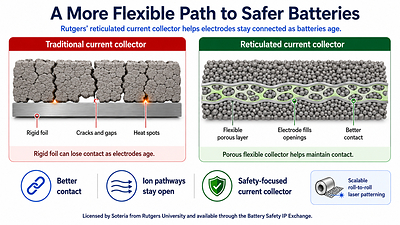
As lithium-ion batteries move toward higher energy densities, the interface between the electrode and current collector is becoming increasingly important to both performance and safety. During repeated charging and discharging, electrodes can expand, contract, crack, and lose uniform contact with conventional metal foil current collectors, leading to increased resistance, heat generation, and degradation over time.
To address this challenge, a team of researchers at Rutgers, led by Amatucci, developed a patented reticulated current collector architecture that replaces conventional solid metal foils with a lightweight, porous polymer structure coated in thin conductive metal layers. The three-dimensional design is intended to improve flexibility, reduce weight, enhance current distribution, support electrolyte transport, and help mitigate resistance growth and heat generation as batteries age.
Recognizing its potential value for next-generation battery designs, Soteria Battery Innovation Group has licensed the technology from Rutgers University and added it to its Battery Safety IP Exchange (IPX), where it will be available to manufacturers through a collaborative licensing framework.
"We believe that current collectors are an underappreciated opportunity to improve battery safety and performance," said Brian Morin, CEO of Soteria Battery Innovation Group. "The Rutgers technology approaches the challenge from a different direction than our own metallized polymer current collector developments, and that's a novel approach we wanted to bring forward into our Battery Safety IP Exchange. By bringing complementary technologies together, we can give manufacturers greater flexibility in how they design safer batteries."
The Battery Safety IP Exchange was established by Soteria's Consortium to help simplify access to safety-enabling battery technologies through a collaborative licensing framework. By assembling complementary technologies from universities, national laboratories, startups, and established companies, the IPX aims to accelerate implementation of practical battery safety solutions across the broader industry. Companies interested in evaluating the Rutgers technology or exploring collaboration opportunities through the Battery Safety IP Exchange are encouraged to contact Soteria Battery Innovation Group. (https://soteriabig.com).
About Soteria Battery Innovation Group Inc.
Soteria is a technology development and licensing company dedicated to advancing battery safety through innovative collaboration. Through its global Consortium, Soteria works with manufacturers, OEMs, material innovators, and researchers to identify pressing safety challenges and collectively advance solutions. By combining technical advancements with cross-industry engagement, Soteria supports practical, scalable safety solutions. Learn more at https://soteriabig.com.
Contact: Amy Brinson
417646@email4pr.com
+1 (864) 609-4165
 View original content to download multimedia:https://www.prnewswire.com/news-releases/soteria-battery-innovation-group-licenses-key-current-collector-technology-from-rutgers-university-to-help-slow-battery-aging-and-improve-safety-302811132.html
SOURCE Soteria Battery Innovation Group